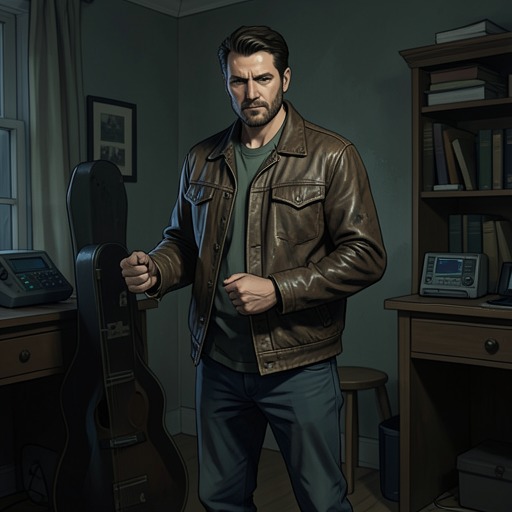
Eddie smashes a guitar after the show
Daisy Jones & the SixEddie smashes a guitar after the show when anger over Billy Dunne’s authority and the way the performance was handled breaks through the band’s public success. Eddie destroys his 1968 Les Paul and leaves the stage; the broken instrument turns an argument about recognition into an unmistakable rupture, even as Eddie immediately regrets what he has done.
Background and the Show
The confrontation follows a performance in which Billy had invited Daisy Jones to sing Honeycomb with The Six. Daisy kept the altered lyrics despite knowing Billy disliked them, and the two singers harmonized at the end in a way that had not been on the record. Karen recalled their close attention to one another as intense; Billy judged the performance the band’s best to that point. The crowd’s response and Daisy’s contribution made the show a success, but success did not erase the tensions within the group.
Billy had also taken Eddie’s guitar during the performance. Graham Dunne acknowledged that the move was neither respectful nor flattering, but believed it made for a better show: audiences came to see Billy and valued his songs. In Graham’s account, the band worked largely as a meritocracy while functioning like a dictatorship. Billy’s authority rested on his talent, but that did not make the hierarchy feel fair to the other musicians. Graham had previously warned Eddie that competing with Billy was a losing battle; Eddie did not accept that as a reason to stop resisting.
Recognition and Resentment
The immediate dispute surfaced after the band played Around to You, with Daisy harmonizing with Billy throughout. Karen noted that The Six had not previously performed a song built around pure vocal harmony, and thought the new arrangement worked. Billy turned to the band and praised everyone’s work, believing they had played an exceptional show. Eddie heard the praise against a larger pattern: Billy’s decisions shaped the performance, while Eddie felt expected to accept Billy’s priorities as the band’s priorities.
The presence of Rolling Stone sharpened that difference. Billy explained that he had wanted to give the audience a particularly good show because the magazine was there. Eddie understood this as another instance in which Billy’s judgment determined what mattered: Billy would ordinarily have let him play, but wanted the performance done right for the press. Their disagreement was therefore not simply about a guitar part or one compliment. It concerned who could set the standard for the band and whose work counted on its own terms.
The Argument and the Smash
After the performance, Billy tried to thank Eddie for what he had done earlier. Eddie would not meet his eyes. Billy eventually tapped him on the shoulder and explained his reasoning about the show; Eddie took the remark as part of Billy’s familiar self-justifying manner. The exchange escalated when Billy challenged Eddie’s attitude, and Eddie answered that he had played well that night. Billy urged him to lower the temperature of the exchange, but Eddie’s resentment was not only about that evening. He was tired of being expected to feel exactly as Billy did about matters that affected him.
Billy then addressed the audience, apparently unaware of how the moment had changed, and announced The Six. Karen saw Eddie lift the guitar from his shoulders just before the lights went out. Daisy and Graham remembered the movement and impact; Eddie later confirmed that he smashed the instrument and walked away. The neck broke, and the guitar came down onto the ground. Eddie identified it as his 1968 Les Paul and said that he regretted the act almost immediately. The damaged guitar made the conflict public in the same space where the band had just received acclaim.
Aftermath and Significance
Rod Reyes saw the contradiction in the scene: the band had just delivered an excellent performance, yet he worried that the dispute between Eddie and Billy might continue backstage. With Jonah Berg about to arrive, Rod took Eddie aside, gave him a glass of water, and asked him to take a few minutes. Eddie resisted that attempt to redirect him, insisting that Billy—not Eddie—needed to back off. The intervention paused the immediate confrontation but did not settle the underlying grievance.
The smash thus marks both the cost and the limit of Eddie’s protest. His guitar had been an instrument in the performance, and its destruction made it impossible to treat the post-show anger as invisible or incidental. Yet Eddie’s immediate regret complicates any reading of the act as a considered break with the band: he walked off in anger and regretted the loss at once. The episode exposes a band whose public effectiveness depended on Billy’s command, while that same command left other members feeling diminished. The show’s success and the backstage rupture are not opposites; the performance could be compelling precisely while the structure behind it remained contested.